Governance • Compliance • Explainability

Boundary2 — Explainable Expense Compliance Platform

Boundary2 redesigns enterprise expense compliance as an explainable, audit-ready decision system that builds organizational trust.

Built in response to the trust gap exposed by AI-assisted approvals, it makes every compliance decision transparent, reviewable, and defensible across employees, finance operations, and compliance teams.

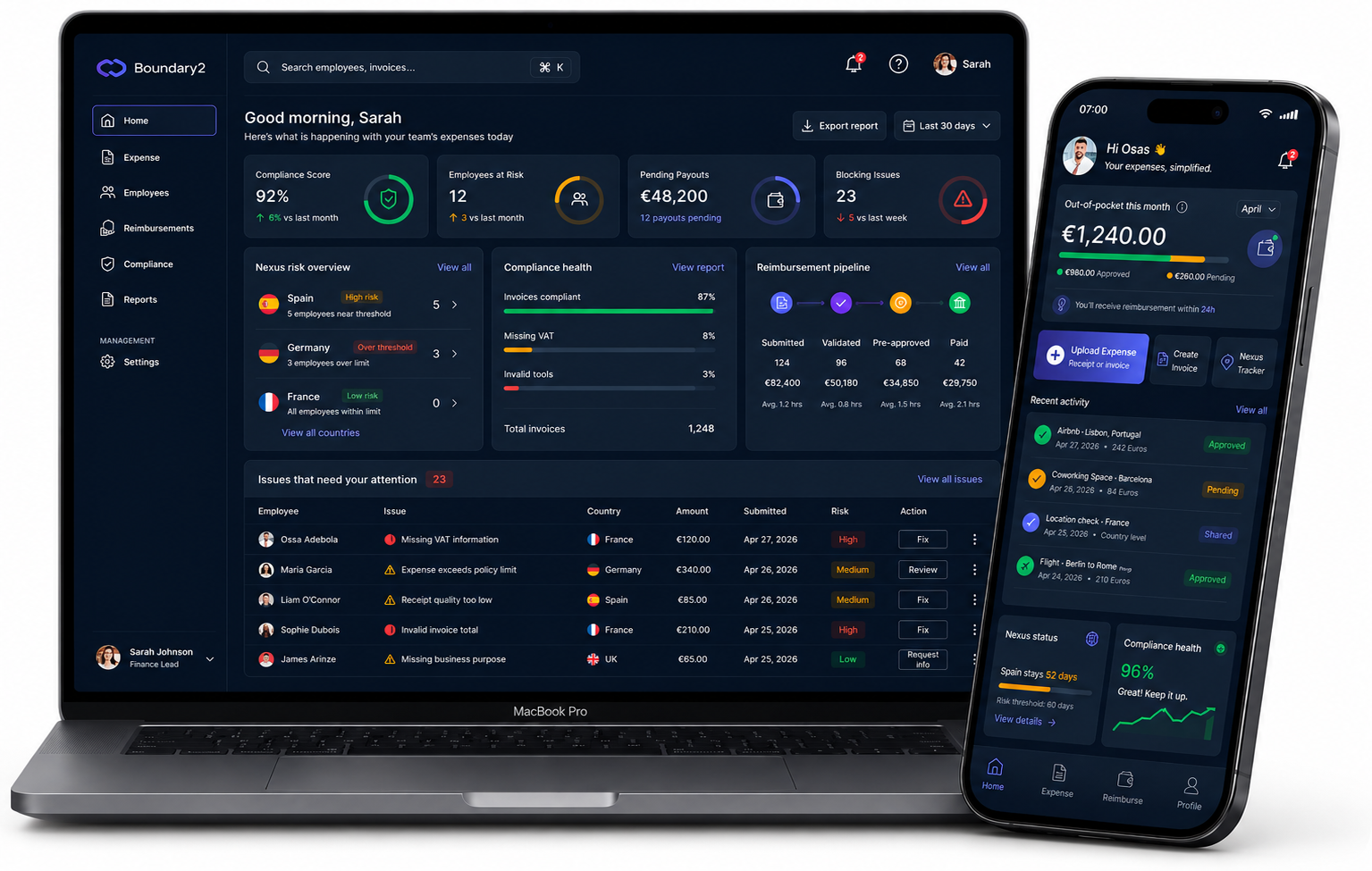
Boundary2 across web and mobile: a shared compliance system for employees, finance ops, and compliance teams.

Project Snapshot

Area Details
Role Lead Product Designer (IC), end-to-end
Duration 12 weeks
Type Concept project, tested prototype
Users Compliance reviewers, Finance Ops, employees submitting expenses
Platforms Web for compliance operations, mobile for employees
Validation 4 moderated prototype sessions, 4 SME reviews, 3 major iterations

The Problem

Boundary1 improved compliance speed using AI-assisted decisioning, but introduced a critical gap:

Decisions were fast — but not explainable or defensible.

This created two breakdowns:


For reviewers

  • Could not trace why a decision was made

  • Could not justify overrides during audits

  • Lacked evidence-linked reasoning

For employees

  • No clarity on how data was used

  • No visibility into verification logic

  • Low trust in compliance outcomes

What I designed

Design Objective

Turn compliance from a pass/fail workflow into a reviewable decision system.


I designed 4 core system capabilities:

1. Explainability Layer

Every decision links to:

  • rule triggered

  • supporting evidence

  • validation outcome

2. Privacy & Consent Layer

  • explicit consent per verification

  • no passive tracking

  • minimum-necessary data usage

3. Auditability Layer

  • full decision history

  • override tracking

  • structured audit logs

4. Recovery Layer

  • structured exception flows

  • no dead-end failures

  • guided correction paths

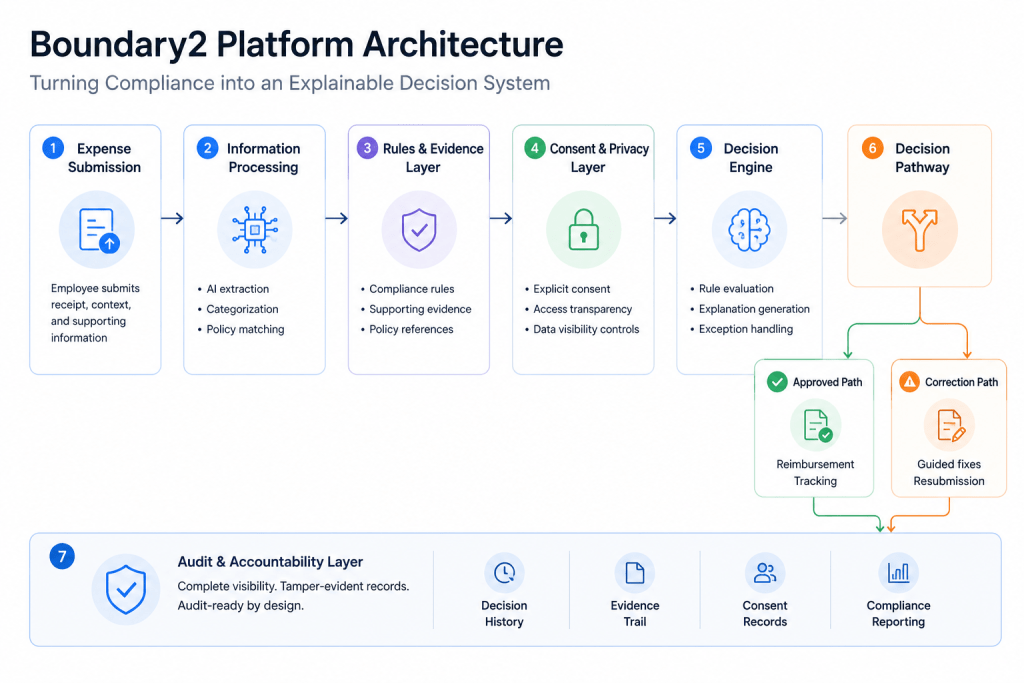
System Model

My design focus:
  • making AI outputs explainable in context

  • making rule evaluation visible to reviewers

  • making human overrides traceable for audit

  • preventing workflow dead-ends via recovery flows

Boundary1 → Boundary2 Transition

System Evolution

Boundary1 Boundary2
Fast approvals Explainable decisions
Hidden AI reasoning Rule + evidence visibility
Limited audit support Full audit traceability
Passive tracking Consent-based verification

Key Product Decisions

Core Trade-offs

Explainability over Automation

  • Increased review complexity

  • Enables defensible compliance decisions

Consent over Continuous Tracking

  • Reduced passive data collection

  • Improved user trust and transparency

Desktop Ops Workspace over Lightweight Flow

  • Added complexity in UI surface

  • Necessary for audit + investigation workflows

Compliance ops workspace

Research showed that compliance work extended beyond approvals.

Reviewers needed a workspace for: 

  • anomaly investigation
  • queue prioritization
  • risk visibility
  • audit readiness across many cases at once

I moved compliance work from a lightweight approval flow into a desktop-first operational workspace.

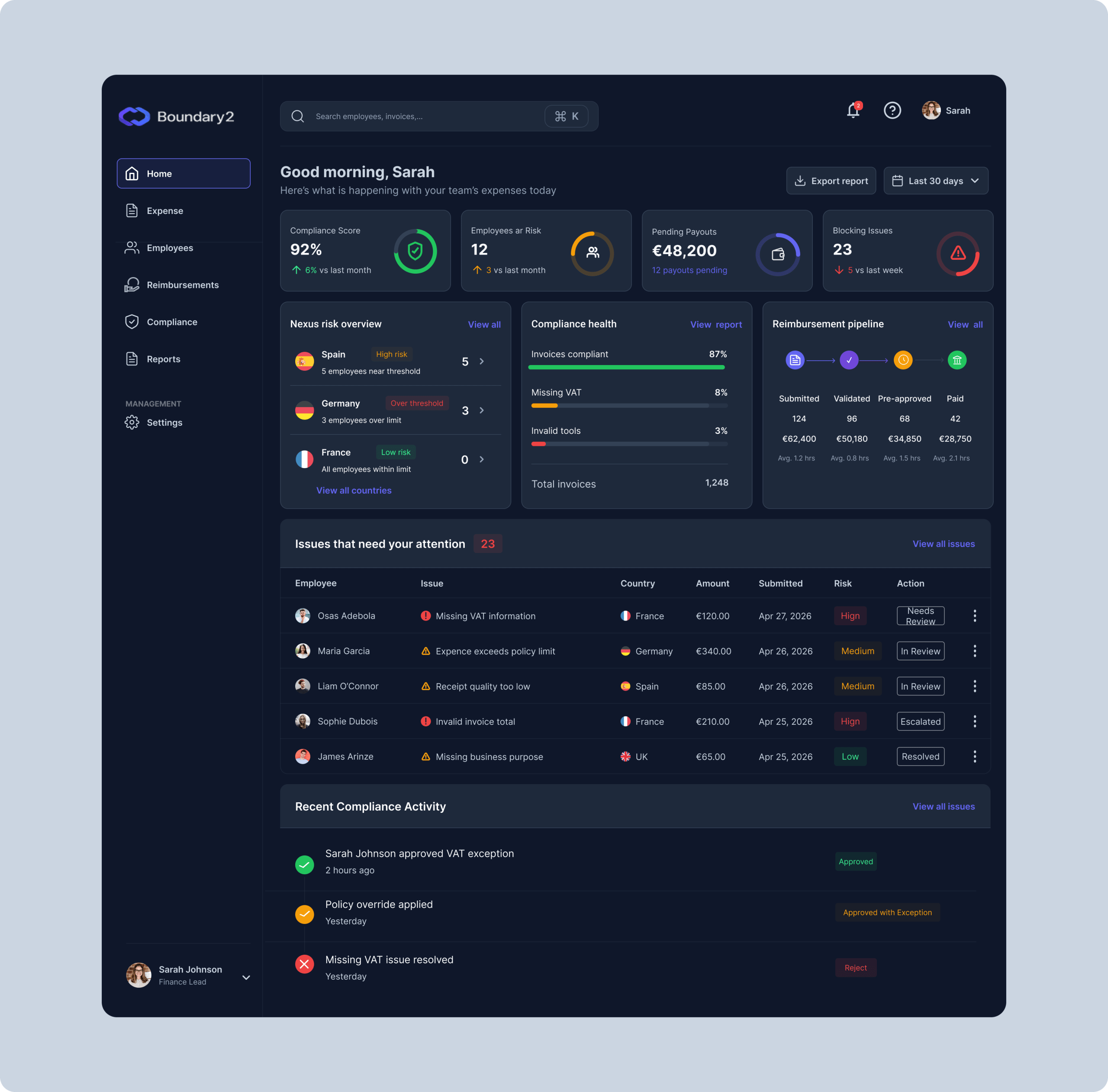
Screen 1: Compliance Dashboard Screen

A centralized compliance workspace for monitoring organizational risk, resolving exceptions, and maintaining audit readiness.

Decision explainability

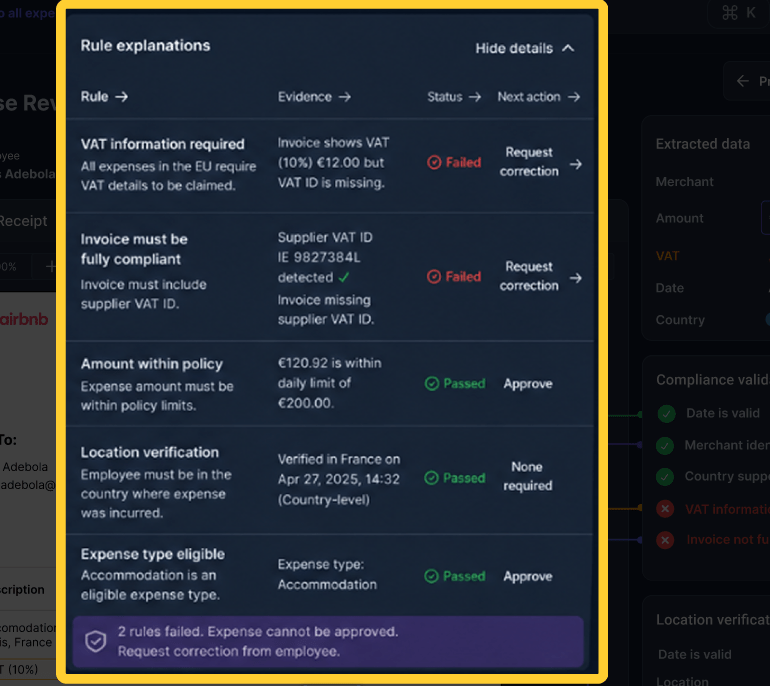
The biggest shift in Boundary2 was making decisions inspectable instead of opaque.

Reviewers did not need more raw information. They needed the minimum defensible explanation:

rule -> evidence -> status -> next action

So I designed the review experience to show not only the outcome, but the logic behind it.

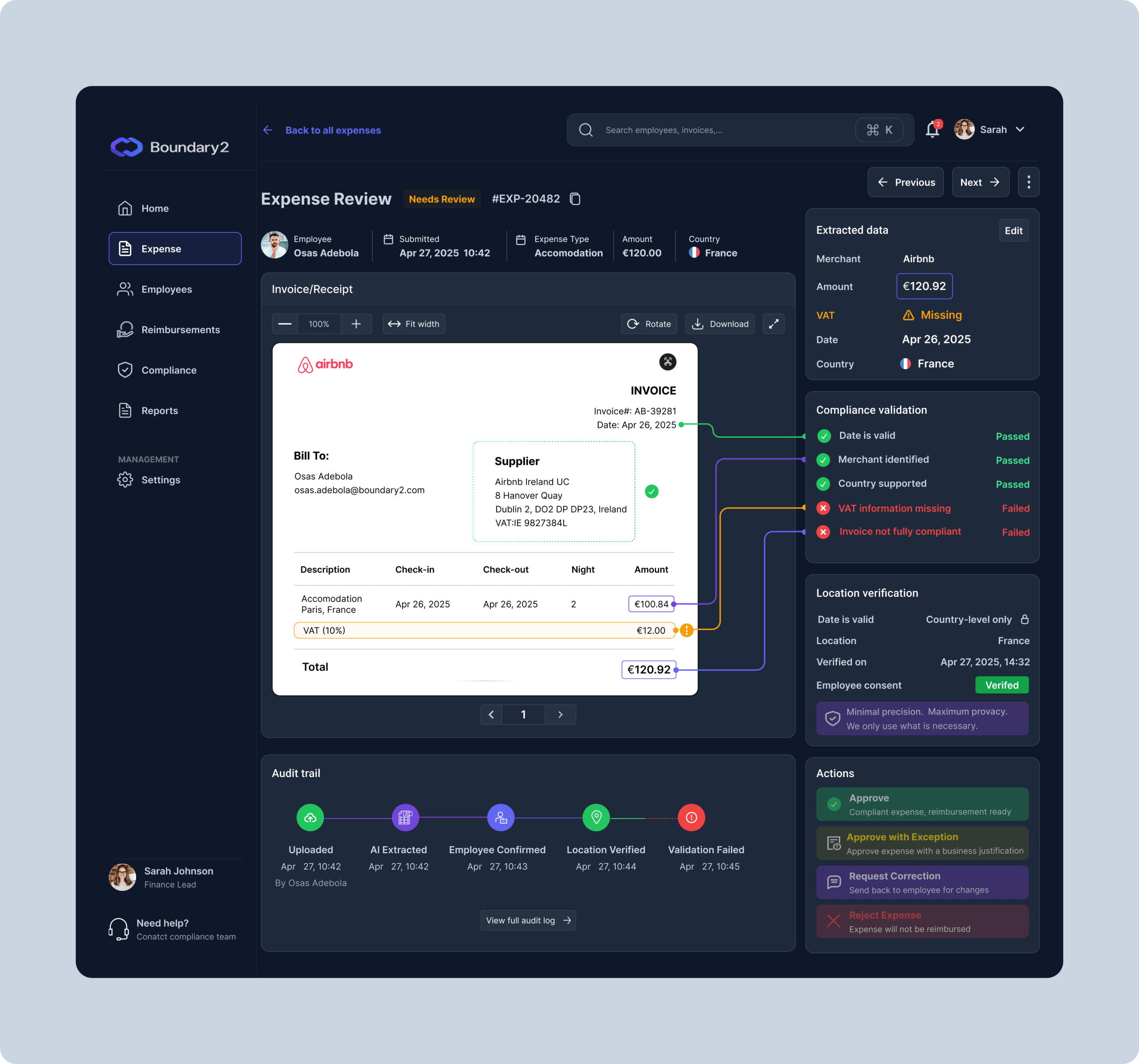
Screen 2: Expense Review Screen

A triage-first review flow that brings rules, evidence, actions, and audit history into one operational view.

Screen 2a: Rule explanations panel (cropped)

Every compliance outcome is linked to the rule, evidence, and validation result behind it.

Consent and verification

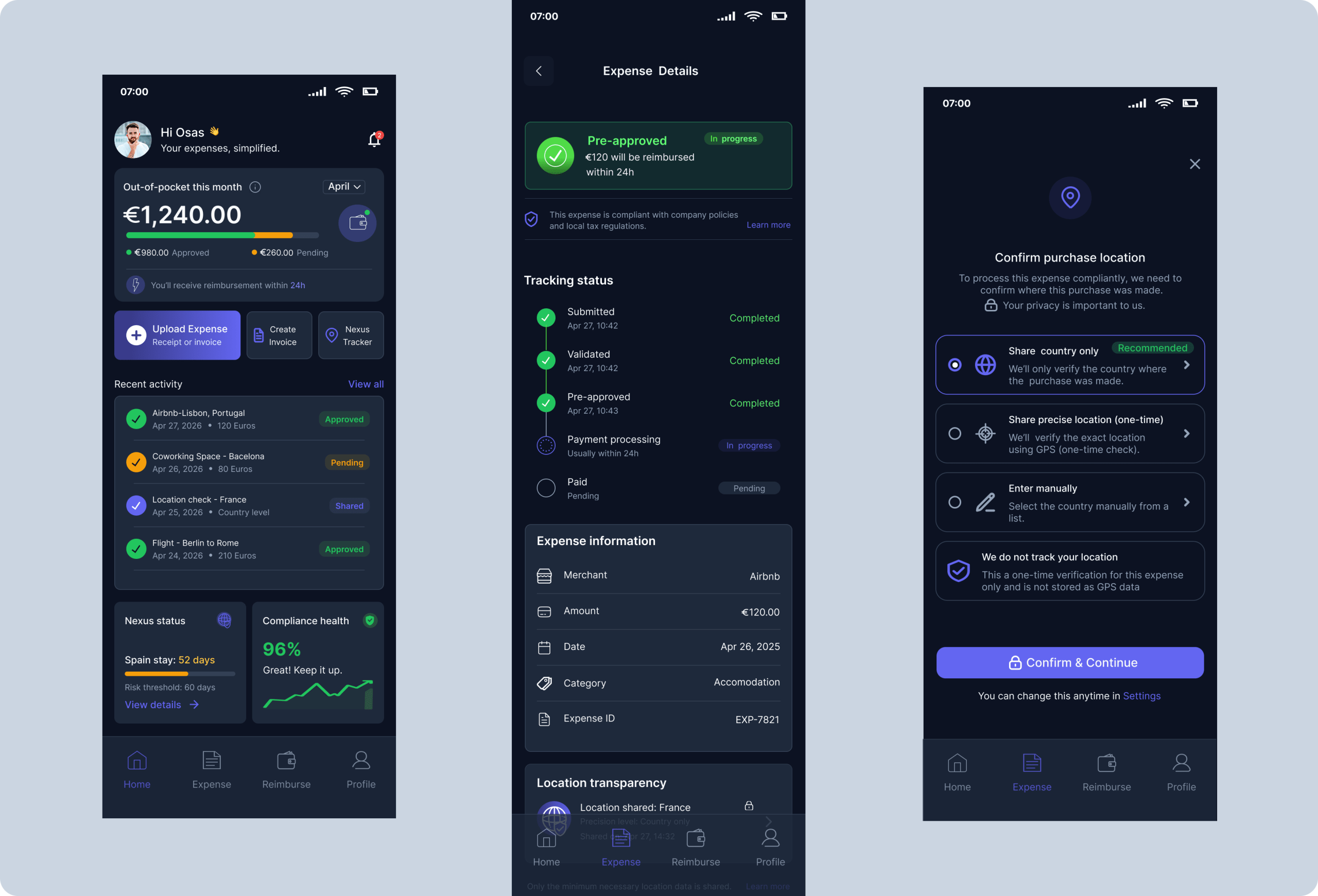
Boundary2 makes compliance-related data usage visible where trust matters most: verification, consent, and status.


Instead of relying on persistent tracking, the system uses explicit, point-in-time consent and minimum-necessary precision for location verification.

Mobile Employee  Screens

The employee experience makes consent, status, and verification visible without exposing users to internal compliance complexity.

Recovery flows

Boundary2 was designed to stay usable when compliance workflows break down.


Instead of treating failures as dead ends, I created structured recovery flows for:

  • missing VAT information
  • payout failures
  • unreadable documents
  • duplicate receipts
  • consent-dependent verification
  • offline capture conditions

The principle behind these flows was simple:

  • when something goes wrong, users should understand the issue
  • they should also know what to do next

Edge cases and recovery flows

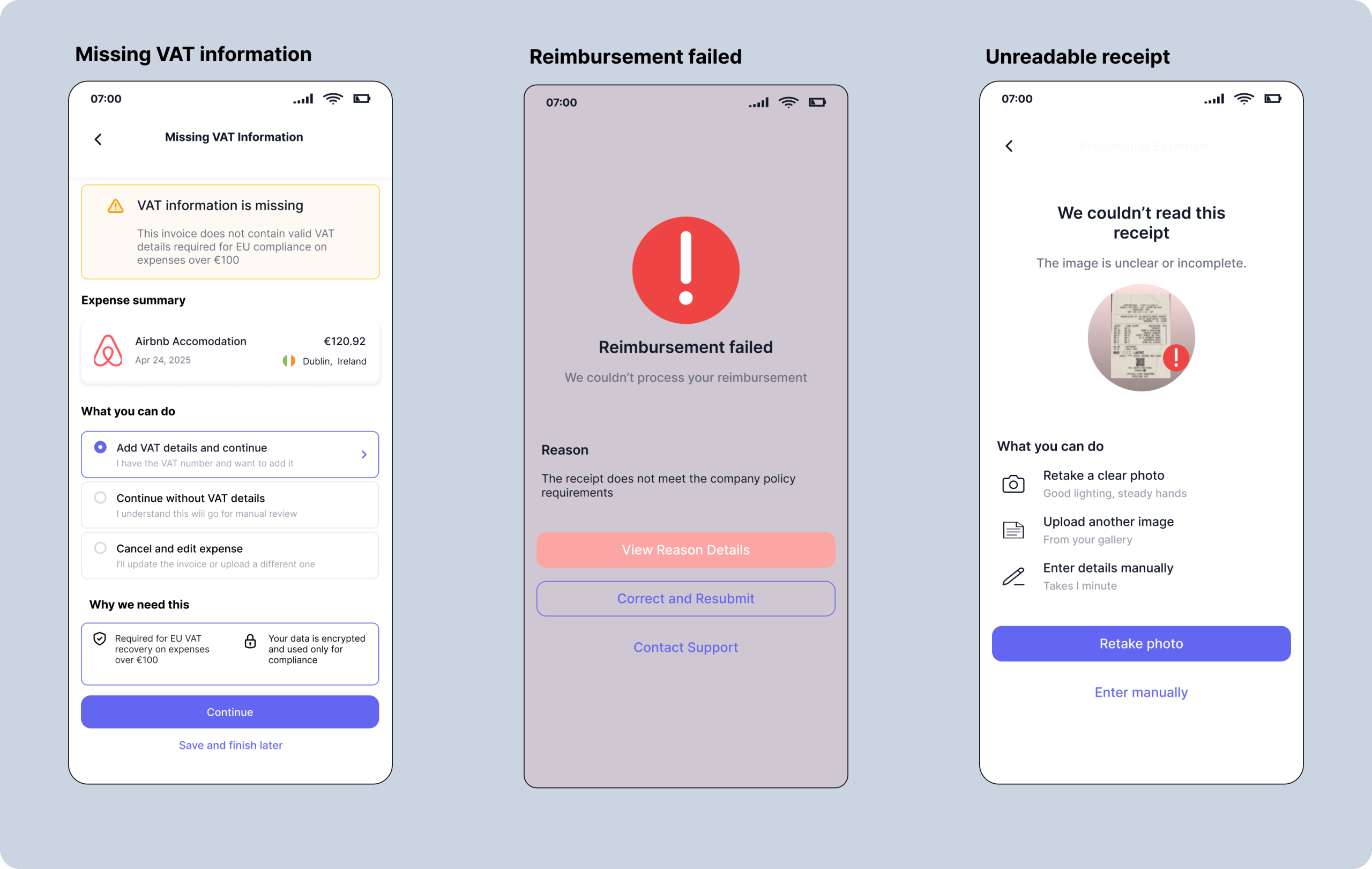
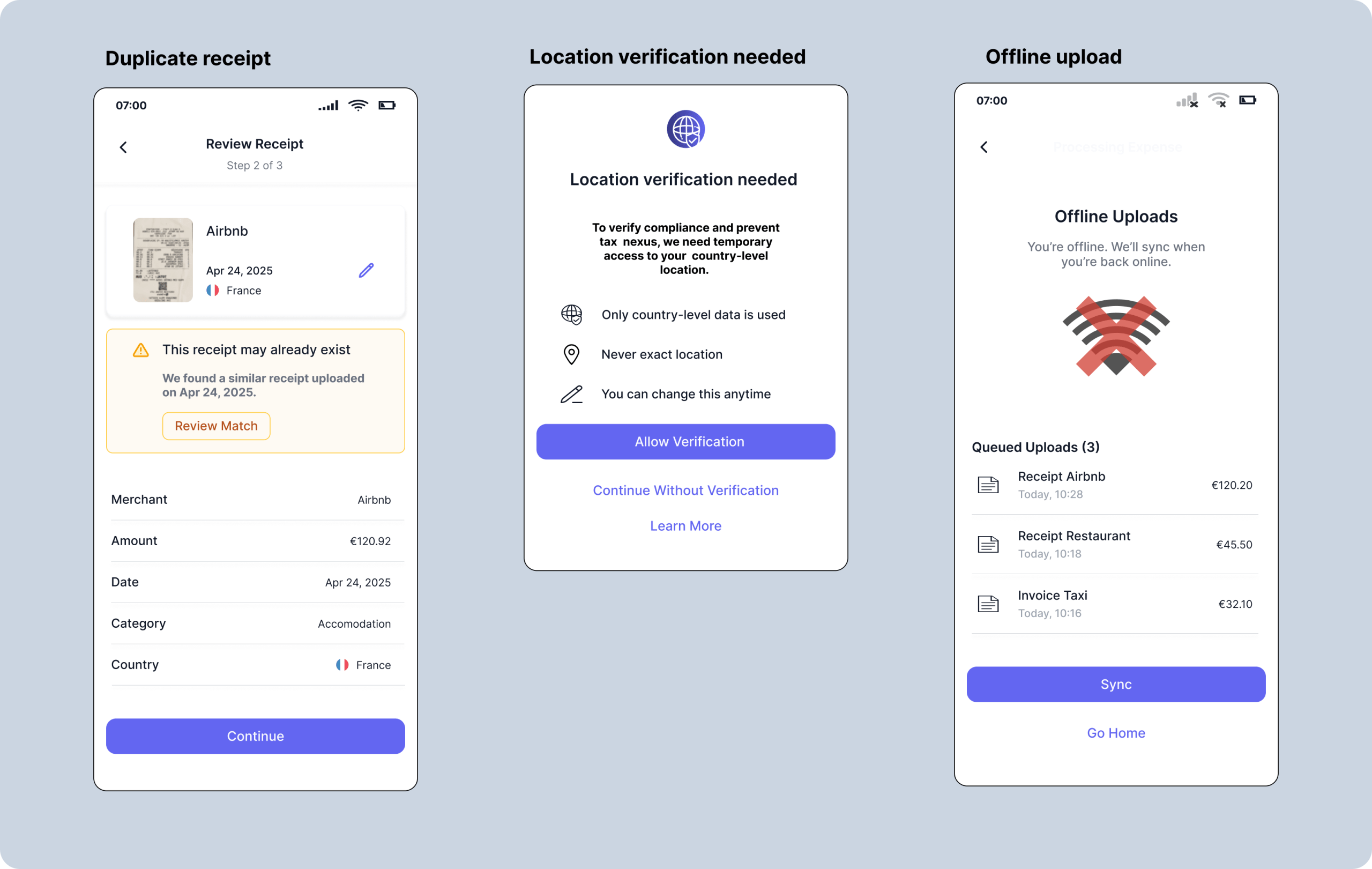
Boundary2 supports recovery across the issues most likely to interrupt expense review.

Missing VAT information

Flags missing VAT details at review time, links the failure to the relevant compliance rule, and routes the case into a correction flow instead of allowing ambiguity to continue downstream.

Turns a compliance blocker into a clear correction path


Payout failures

Surfaces payout failure clearly, explains the issue, and preserves next-step actions without breaking the workflow.

Keeps payout issues actionable instead of opaque


Unreadable receipt

Routes low-confidence extraction into a guided correction flow instead of a silent failure, keeping the issue visible and recoverable.

Turns document failure into a clear next step

Duplicate receipt

Flags possible duplicate submissions early and helps users resolve the conflict before the expense moves further into review.

Reduces duplicate reimbursement risk upstream


Location verification needed

Requests access only when compliance verification is required, with explicit purpose and minimum-necessary precision.

Supports privacy-first, audit-aware verification


Offline upload

Lets employees continue expense capture in low-connectivity conditions, preserving submission progress until sync is restored.

Prevents submission loss at the point of capture

Validation and iterations

I tested Boundary2 through:

  • 4 moderated sessions with employees, finance ops, and compliance leadership

  • 4 SME reviews with compliance and privacy stakeholders.

What validation confirmed

  • trust increases when decisions are tied to rule + evidence

  • reviewers prefer minimal defensible explanation over full data exposure

  • structured recovery reduces workflow breakdowns

  • consent visibility improves employee confidence

What changed through iteration

  • 1 → 2: moved validation and evidence higher in the hierarchy, and added a concise validation summary
  • 2 → 3: grouped validation results into clearer categories and reduced visual noise
  • 3 → 4: introduced a persistent audit trail, structured exception actions, and clearer privacy cues around verification precision

Outcome

Boundary2 transforms compliance from an opaque approval system into a transparent decision infrastructure that:

  • improves audit defensibility
  • increases trust between employees and compliance teams
  • reduces ambiguity in exception handling
  • supports scalable enterprise compliance workflows

Reflection

I learned that in compliance systems, transparency is not a feature — it is the product itself.

Trust is created when decisions are:

  • understandable
  • reviewable
  • accountable

VoiceOps — AI Voice Operations System

Contact Form Demo