AI Operations • Human Oversight
VoiceOps — AI Voice Operations System
Monitor, govern, and continuously improve autonomous voice agents in production.
As AI voice agents move into production, success depends on more than recognition accuracy. Teams need visibility, operational control, and human oversight when conversations become uncertain.
VoiceOps explores how operations teams monitor AI conversations, identify risk, and intervene with confidence.
Project Snapshot
| Area | Details |
|---|---|
| Role | Lead Product Designer |
| Timeline | 4 Weeks |
| Status | MVP in Development |
| Scope | Product Strategy, UX, UI, Prototype |
The Opportunity
Building AI voice agents is only half the challenge. Operating them in production is the other.
As organizations deploy AI voice agents across customer support, collections, and sales, they face a new operational reality: conversations become unpredictable, edge cases emerge, and human intervention remains essential.
In 2024, McDonald's ended its multi-year AI drive-thru pilot after real-world deployments highlighted these challenges at scale—from handling uncertainty to managing complex customer interactions.
This raises a broader question:
What tools do operations teams need once AI voice agents are in production?
Why VoiceOps?
As organizations deploy AI voice agents across customer support, collections, and sales, they need more than deployment tools.
They need operational visibility, explainability, governance, and human oversight.
VoiceOps is designed to become that operational control layer.
VoiceOPs Workflow
Customer
↓
AI Voice Agent
↓
Live Conversations
↓
VoiceOps
Monitor • Detect Risk • Investigate • Govern • Improve
Key Operational Questions
VoiceOps was designed around the questions operations teams need answered while supervising AI voice agents in production:
- How many AI sessions are active right now?
- What percentage are being resolved autonomously?
- Are human handoffs increasing?
- Which conversations require review?
- Where is customer sentiment declining?
- What should happen after an escalation?
MVP Scope
The first release focuses on the three operational workflows required to supervise AI voice systems in production.
Observe
↓
Investigate
↓
Resolve
Product Walkthrough
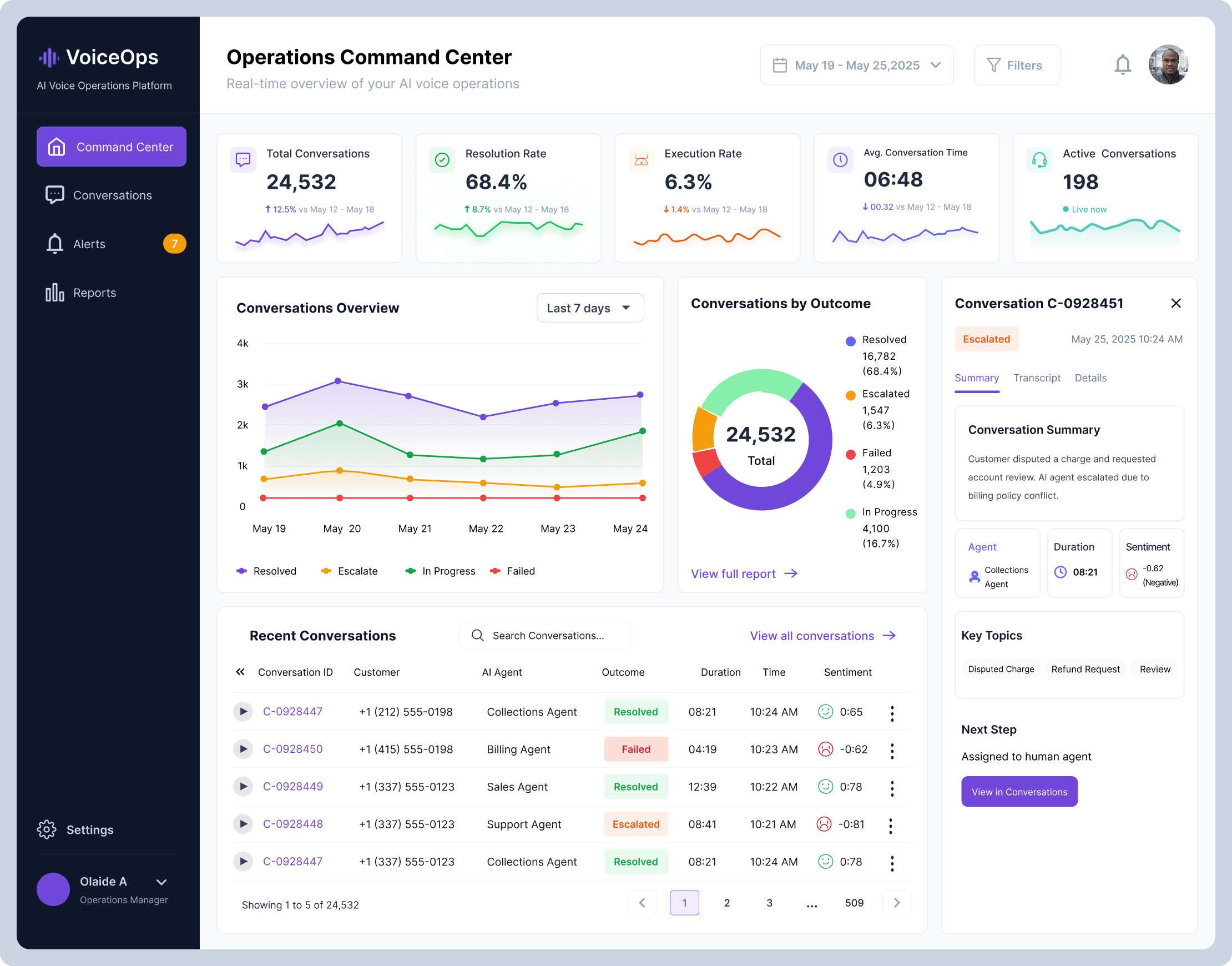
Observe — AI Operations Command Center
Why this layout?
Operators first need to understand overall system health and identify anomalies before investigating individual interactions. The dashboard prioritizes trends, KPIs, and anomalies to support rapid triage.
This screen answers
- How many AI sessions are active?
- What percentage are being resolved autonomously?
- Are human handsoffs increasing?
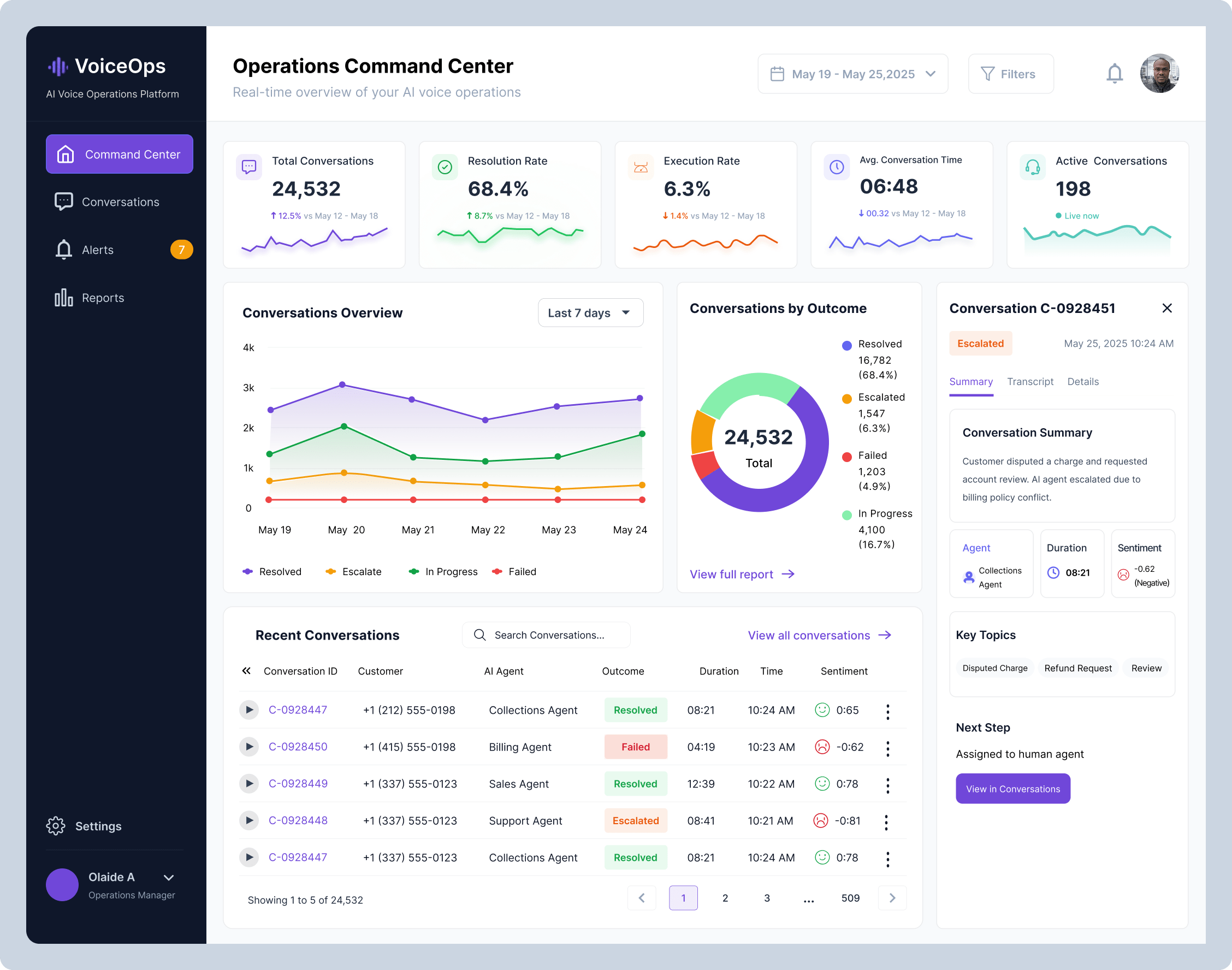
Investigate — Conversations Feed & Lifecycle History
Why this layout?
The feed emphasizes operational signals—status, sentiment, outcomes, and lifecycle events—allowing teams to identify high-priority interactions before opening a full workspace.
The screens answers:
- Which AI sessions require review?
- Where is customer sentiment trending negative?
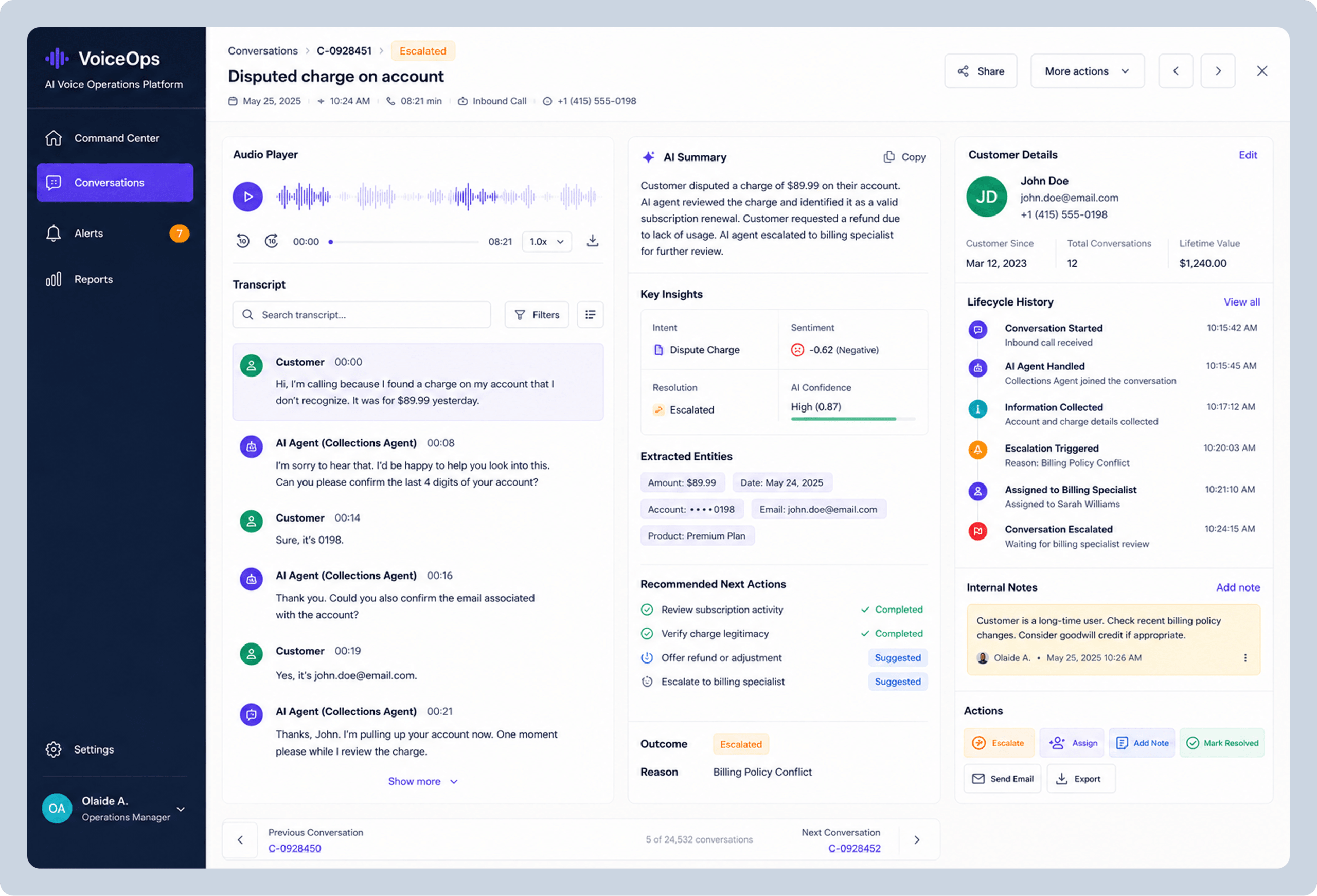
Resolve — Conversation Workspace
Why this layout?
The workspace consolidates transcripts, AI summaries, reasoning, and resolution tools into a single view, minimizing context switching during investigations.
It is the investigation and action workspace where operators ask:
- What action should follow this escalation?
Design Principles
Observe
- Operational Visibility Before Investigation
Operators need to understand overall system health before inspecting individual interactions. The dashboard surfaces trends and anomalies first, enabling faster prioritization. - Designed for Operational Scale
Information hierarchy, reusable components, and progressive disclosure help teams supervise hundreds of AI interactions without overwhelming the interface.
Investigate
- Investigation Without Context Switching
Everything needed to understand an AI interaction—including transcripts, summaries, metadata, lifecycle history, and actions—is brought into a single workspace to reduce cognitive overhead. - Explainability by Default
AI decisions should never appear as black boxes. Confidence indicators, reasoning summaries, and lifecycle history provide the context needed to understand how an outcome was reached.
Resolve
- AI-First, Human-Supervised
AI should automate routine work, but operators must remain informed and in control. Every workflow is designed to support confident human intervention when required. - Human Intervention as a First-Class Workflow
Escalation is not treated as failure. The interface supports smooth transitions between autonomous AI handling and human decision-making, preserving context throughout the investigation.
Together, these principles shaped every interface in the MVP—from the Command Center to the Conversation Workspace—ensuring the product supports real operational decisions rather than simply visualizing AI activity.
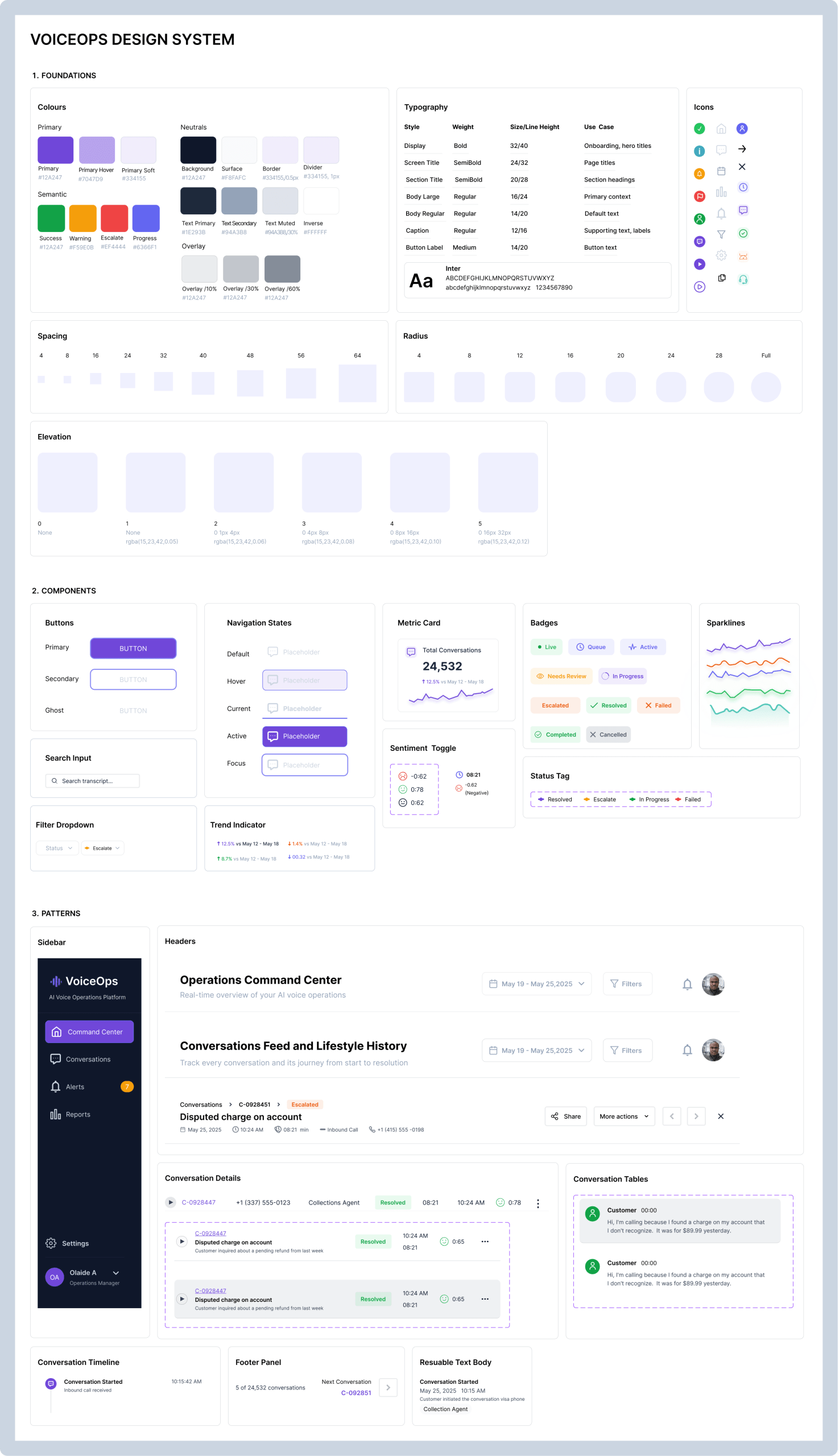
Design System Foundations
A lightweight design system was designed that establishes the visual language, reusable components, and interaction patterns needed to scale the VoiceOps platform.
Communicate
- Semantic Colors
- Typography
- Status Components
Structure
- Spacing
- Grid
- Components
Scale
- Design Tokens
- Reusability
- Consistency
These foundations allowed new workflows to be designed quickly while maintaining a consistent operational experience across the MVP.
Roadmap
The MVP establishes the core operational workflows for supervising AI voice agents in production. Future iterations will expand the platform's governance, observability, and continuous improvement capabilities.
Today
│
├── MVP
│ ✓ Observe
│ ✓ Investigate
│ ✓ Resolve
│
└──────────────►
Next
• AI Evaluation
• Prompt Management
• Analytics
• Knowledge Base
• Reporting
• Governance
Reflection
VoiceOps reinforced an important product design principle: successful AI products are defined not only by the intelligence of their models, but by the quality of the operational systems that support them. Designing the MVP around three core workflows—Observe, Investigate, and Resolve—helped me prioritize clarity, governance, and human oversight over feature complexity.
VoiceOps demonstrates how thoughtful product design can bridge the gap between AI capability and operational trust—turning autonomous voice agents into systems that organizations can confidently supervise at scale.